
A recent SFGate story described a travel nightmare at Ellison Onizuka Kona International Airport (KOA) — one that reveals more than just an unlucky delay.
The article recounts how an early January delay forced passengers on a flight to Anchorage to spend the night sleeping where they could on airport grounds after losing their takeoff window.
A bit of a backstory here – KOA has been managing runway cracking issues for years. Because it has only one runway, repairs happen overnight — which means strict departure curfews. Even small delays can push a flight past the cutoff and cancel it, leaving little margin for error when schedules slip. So far, the State Dept of Transportation, airports division (DOT-A) has been working on repairs, mostly overnight when aviation activities allow work on the runway to happen.
In this case, delays pushed the Anchorage-bound flight right up against the curfew, and it ultimately lost its departure window. When the flight turned back, the airline did not arrange accommodations for passengers, leaving many to sleep wherever they could. In the first-person account of this incident, the travellers had an inflated kayak and so used it as a bed.
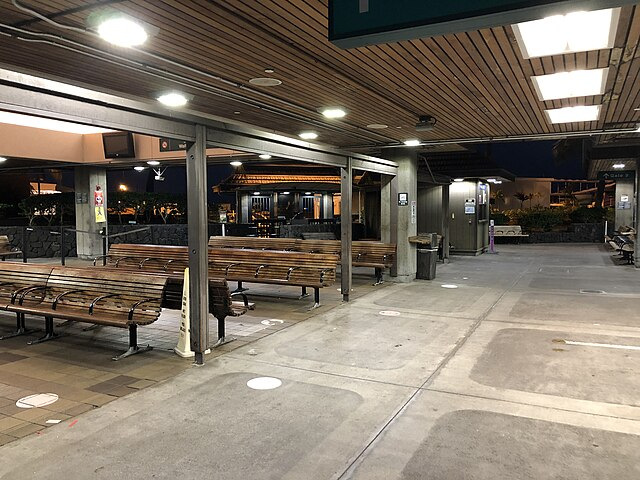
PC: Famartin, CC BY-SA 4.0 https://creativecommons.org/licenses/by-sa/4.0, via Wikimedia Commons
But beyond the inconvenience lies a bigger question: who was actually in charge when the system started to unravel? That question becomes sharper in Kona, one of Hawaiʻi’s primary visitor gateways and a place the state proudly presents as its “best foot forward.”
According to HDOT’s statement in the article, the initial delay stemmed from a “checkpoint security boarding error,” a term that has not yet been publicly explained but points to an issue at the Transportation Security Administration (TSA) screening level. No further details have been made public, but it does show that the initial issue point was at the security level, pointing to an initial issue at TSA screening operations.
From there, the chain reaction unfolded. Flights missed their window. Agencies operated within their own rules. Passengers were left guessing. To borrow from Cool Hand Luke, what we had here was a failure to communicate — and no clear playbook for who steps up when communication breaks down.
Breaking it down, three distinct players were involved. The first is TSA. The second is the airport operator itself, which in this case is DOT-A. And the third is the airline (in this case, Alaska Airlines). All three normally operate in the background, and the system appears seamless when flights run on time. In most cases, travellers donʻt necessarily see the bright red lines of who is in charge of what when going through the airport.
But when something goes wrong, the gaps between those groups become painfully obvious.
With TSAʻs job being security, and not customer service, and airport management is more along the lines of keeping operations both safe while also trying to be nice to the customers, it falls to the airline to be the primary point of direct customer care, from check-in through arrival. When plans fall apart, the airline is the face that passengers look to first. This is especially important in Hawaiʻi, where the state places high value on the visitor experience and the reputation of its tourism industry.
So, going back to the story, where the Alaska staff cited logistical constraints — namely, trying to find hotel rooms on Aliʻi Drive for hundreds of passengers with late-night transportation. The situation appears to have exceeded what their standard service recovery system was prepared to handle.
At least for the passengers telling the reporters at SFGate about this.
PC: Sonya Green, CC BY 2.0 https://creativecommons.org/licenses/by/2.0, via Wikimedia Commons
Despite the lack of accommodation and what sounds like a paltry amount in the form of a voucher for food (and if you have ever gone through KOA and their food stalls, $20 will get you something, but not a full banquet), even in this case, the airline is not totally on the hook for all the blame. Their actions are covered by the fact that under Department of Transportation consumer rules, airlines generally have fewer obligations to provide lodging or compensation when delays stem from airport, weather, or security issues outside their direct control.
And in this case, that would be what happened at TSA, combined with the curfew time for operations, running into each other like two independent constraints colliding at the worst possible moment.
With that, the third party involved in all this – the State of Hawaiʻi DOT-A – what could they have done to mitigate this? One might argue that a little more flexibility could have avoided the situation entirely. But runway closures tied to construction schedules exist for safety and infrastructure reasons, and those rules are not easily bent.
However, to their credit, DOT-A adhered to the established construction and safety schedule. With that and passengers now in the terminal area being told “you are on your own,” one would expect DOT-A to have a contingency plan for exactly this type of scenario.
That raises practical questions. Could DOT-A have activated a local support network — such as visitor assistance groups — to provide kokua and comfort? Could KOA have a contingency plan for overnight stranding, including basic rest accommodations, given that runway curfews make this type of scenario foreseeable?
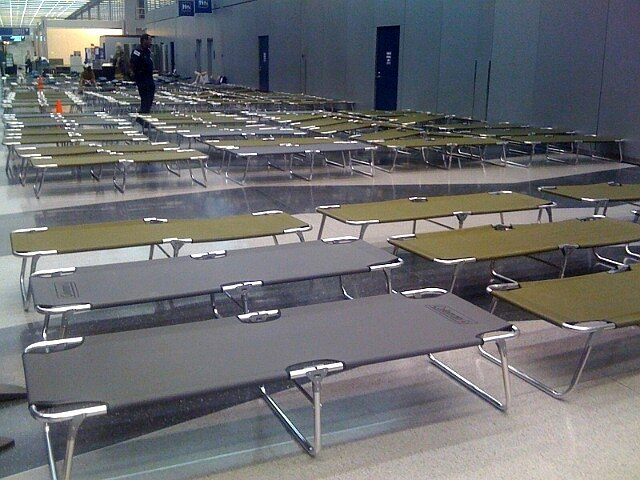
For the second point, some larger U.S. airports treat mass overnight stranding as a temporary sheltering event, activating operational plans that include cots and coordination with local support organizations.
In the end, this episode should prompt all three players — TSA, the airline, and the State of Hawaiʻi — to examine how coordination and passenger care can improve when disruptions cascade. Hawaiʻi invests heavily in promoting a world-class visitor experience. Making sure stranded travelers are not left to fend for themselves on an airport floor is part of delivering on that promise — especially when the breakdown happens in plain view of the visitors the state works so hard to attract.