
Driving into the office on Wednesday, January 14, it looked like it would be one of those rare idle days — the kind where you finally clear out the backlog, return a few calls, maybe get ahead of something for once. No fires. No emergencies. No “drop everything” emails waiting in the inbox. Just another quiet workday.
It wasn’t.
The day started with an email from a program officer at the State of Hawaiʻi Department of Health, informing our campus — Kapiʻolani Community College — that the U.S. Substance Abuse and Mental Health Services Administration (SAMHSA), within the federal Department of Health and Human Services, had determined certain awards were “no longer effective to achieve the program goals or agency priorities.”
In plain terms, grants that had already been awarded were suddenly deemed misaligned with current federal priorities — priorities now being reset across agencies by the Trump White House.
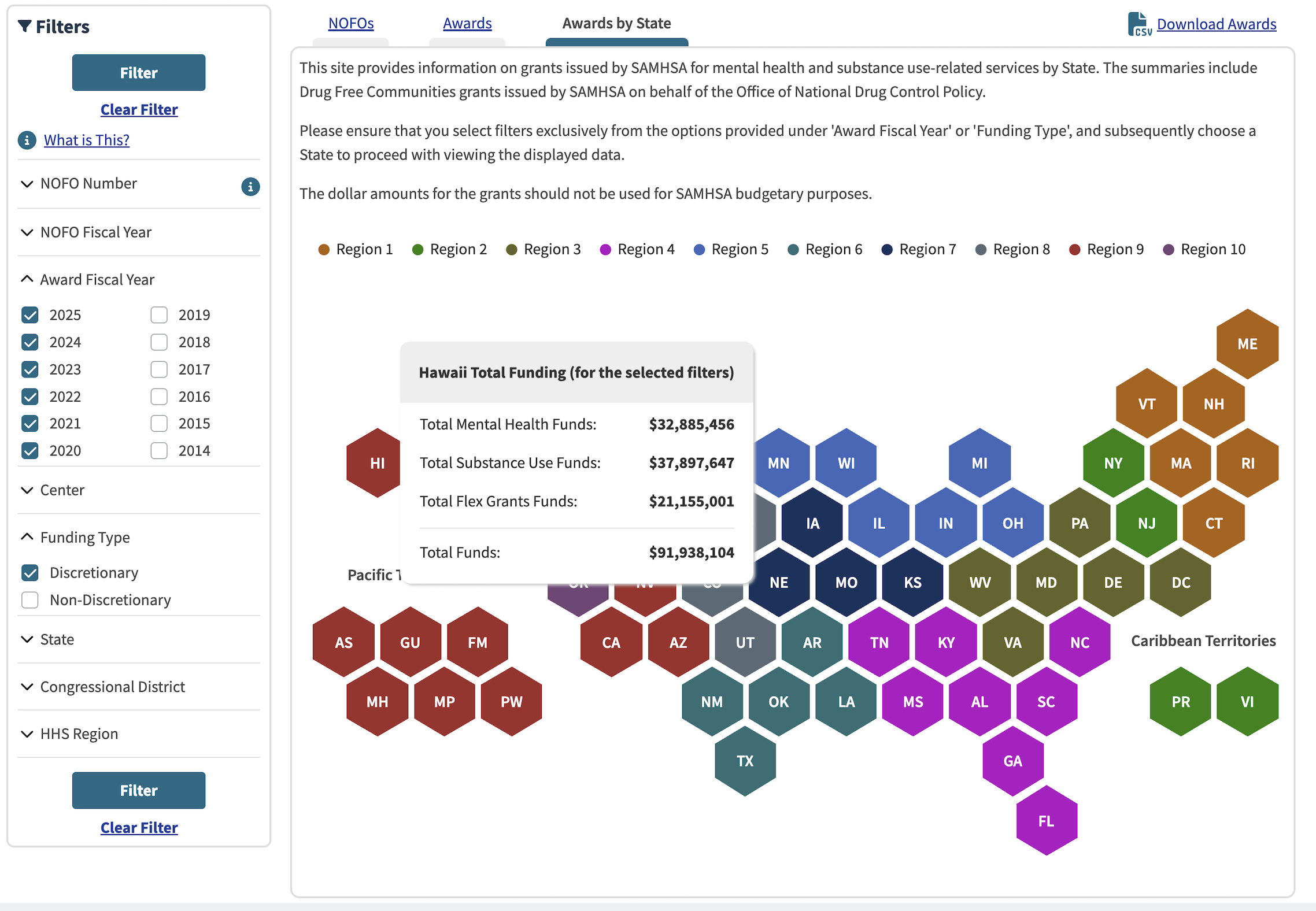
PC: PHwSF via the SAMSHA Grants Dashboard found at https://www.samhsa.gov/grants/grants-dashboard
As a result, SAMHSA moved to cancel grants nationwide. According to reporting by NPR, which was tracking the unfolding situation in real time, the scope of the cancellations was sweeping: roughly $2 billion in mental health and substance-use funding, effectively wiped out in one stroke.
For Kapiʻolani, that meant one program was immediately caught in the blast radius: Malama First Responders: Support EMS Personnel Serving Rural Hawaiʻi Through Training, Resources, and Enhancement of Peer-to-Peer Network. The project provides mental health support to Emergency Medical Services personnel — first responders doing demanding, high-stress work in rural communities across the islands.
With the notice in hand and no ability to appeal, the rest of the day became an exercise in damage control: informing department heads, administrators, and partners that a project we had recently extended was, at least for the moment, gone.
Later that day, word came down that folks on the SAMSHA side had not been aware that the termination notices were coming. It reinforced a growing sense that, as with many actions of this federal administration, decisions were made abruptly, with little apparent consideration for how they would be implemented downstream.
Because of its nationwide reach, subsequent reporting by NPR noted that once the termination notices went out, a wide range of vested interests — nonprofits, advocates, and state officials — immediately got on the phone and began pressing members of Congress to intervene.
It appeared to have an effect. Within twenty-four hours of issuing the cancellation notices, SAMHSA sent out a follow-up message to grant awardees stating that the terminations were rescinded. In essence: disregard the prior notice and continue operating as you were.

PC: PHwSF
If, as a reader, your reaction to that sequence is something along the lines of “say what?”, you are not alone. As the news spread, the word “whiplash” started circulating, because in the span of a single day, the message shifted from “shut everything down” to “never mind, keep going.”
For those of us who grew up in the 1980s, there was a word for this kind of move: “psyche.” Someone would wind up like they were about to head-butt you, pause just long enough to trigger panic, then brush their hair back and say, “Psyche.”
That, in effect, is what played out here — except this time it wasn’t a schoolyard fake-out. It was federal policy.
So, by the time Friday morning, January 16th. came around, everything had technically returned to where it was just days earlier. Programs funded by SAMHSA were still funded. Award information was restated. The machinery of government clicked back into place. And in the words of Cornelius Fudge, Minister of Magic in Harry Potter and the Prisoner of Azkaban, “so that’s that and no harm done. Pea soup?”
That sentiment only works if you assume the people involved could simply switch off the anxiety, the uncertainty, and the immediate disruption that followed. For everyone else — especially those running programs, managing staff, or serving communities already under strain — the damage wasn’t theoretical. It was real, even if it was brief.
There’s a line often attributed to Lee Kuan Yew, former Prime Minister of Singapore, about governing that feels uncomfortably relevant here: that leadership isn’t a game, and that decisions made at the top carry consequences for real lives below. Systems can’t be knocked down for effect and then declared whole again simply because the order was reversed.
Public health funding, especially in places like Hawaiʻi, doesn’t operate on bravado or impulse. It operates on trust — on the assumption that when the federal government commits, programs can plan, staff, and serve without wondering if the ground will suddenly shift beneath them.
After this episode, that assumption is harder to make, and that may be the most lasting consequence of all.