
While this blogger was attending a conference in Washington, D.C. during the week of March 15, 2026, a blockbuster event unfolded on the other side of the country—California. It would only be after returning to Hawaii that the revelations against Farmworker Union leader César Chávez came to light, with immediate effects from it.
During that week, within 72 hours, accusations against the former United Farm Workers Union head came to light, with immediate actions to de-emphasize Chavez in celebrations, holidays, and roads named after him. Now there are movements to change the names of state holidays that honor him, to focus more on the people that he served – the farmworkers in California, Arizona, Texas, and other associated areas.
Recent reporting has raised serious allegations of sexual abuse involving women and minors tied to Chávez, along with claims of long-standing silence within the movement. I won’t go into the details here, but this well-written article is worth the read if you want the full picture

PC: Ali Eminov from Wayne, Nebraska, USA, CC BY 2.0 https://creativecommons.org/licenses/by/2.0, via Wikimedia Commons
What has been intriguing, though, is how quickly things moved from mere information release to a judgment on Chávez himself, complete with actions to strip his name from things. It shows, again, that the social credit of any one person—even one as revered as Chávez—can be taken down quickly. And once it falls, it is rarely restored.
And it also shows how the construction of our modern-day “heroes” happens. While not a hard and fast rule, raising someone in a movement or in society to the level of being revered many times strips away the complicated nature of the person themselves.
Instead of resolving those issues so that they are seen as “flawed but clean” in the eyes of society, the “sins”, if you will, of that person are buried one way or the other. Some dismiss these issues outright. Others choose to bury them entirely.
And that is why César Chávez is a useful case study precisely because the problem is not simple.
His place in American public life was not invented out of thin air. He helped build one of the most recognized farmworker movements in the country, co-founded what became the United Farm Workers, and became a symbol of labor rights, Latino political identity, and moral struggle on behalf of people long ignored by power. That is why his name ended up on schools, streets, parks, and public memorials across the country.
And that gets to the larger point. The same reverence that elevated Chávez may also have helped shield him from scrutiny.
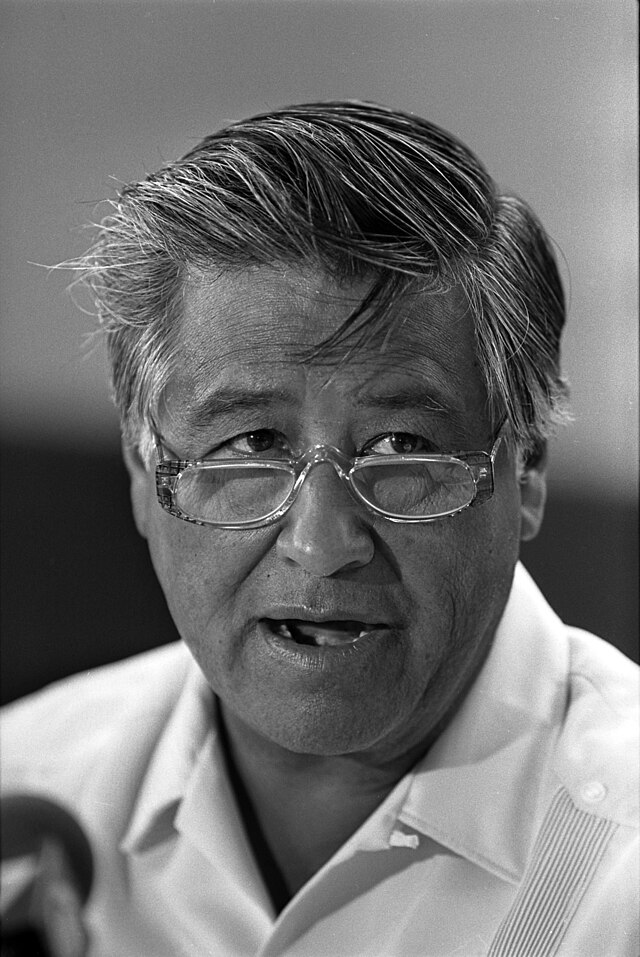
PC: Los Angeles Times, CC BY 4.0 https://creativecommons.org/licenses/by/4.0, via Wikimedia Commons
When a figure becomes bigger than the movement, protecting the symbol can begin to matter more than confronting the truth. That appears to be part of the reckoning here. The recent reports and subsequent reactions from advocates have centered not just on the allegations themselves, but on the culture that allowed silence to persist. Because too many people believed the cause was too important, the icon too valuable, and the damage to the movement too great if the story came fully into view.
Ultimately, those directly affected—including his co-founder, Huerta—chose to put the record forward, regardless of the impact on the movement.
At the end of the day, it seemed that the Chávez enigma appears to have been built on a structure that always carried the risk of collapse as it did. And that is the peril of political and social hero worship.
The lesson to all public leaders, and those who lead in organizations that have a reverence for title and position, accountability delayed doesn’t fade—it accumulates. And when it finally surfaces, it doesn’t ease in. It hits all at once, collapsing reputations, reversing public sentiment, and forcing a rapid reassessment of what was once beyond question.
Chávez, in that sense, is not just the subject of the story. He is Exhibit A for how fragile public sainthood really is.
The hard question is whether it is wise to build our leaders as heroes at all? Because at the end of the day, the practice of building up a hero for the sake of a movement or organizational structure today sets up that same person for an inevitable fall from grace when detrimental disclosures are made of the person.
Or, despite this development, does the human condition that allows for this to happen, and thus affect society in detrimental ways, show us to be, as said by Plutarch to Katniss in his letter at the end of Hunger Games Mockingjay, part 2, “stupid beings with poor memories and a great gift of self-destruction.”
Or, as a concurrent, again from the movie, we will “enter a period where everyone agrees that our recent horrors should never be repeated.” And unlike in the past, the lessons stick for longer than just the usual moment.
We’ll see.