
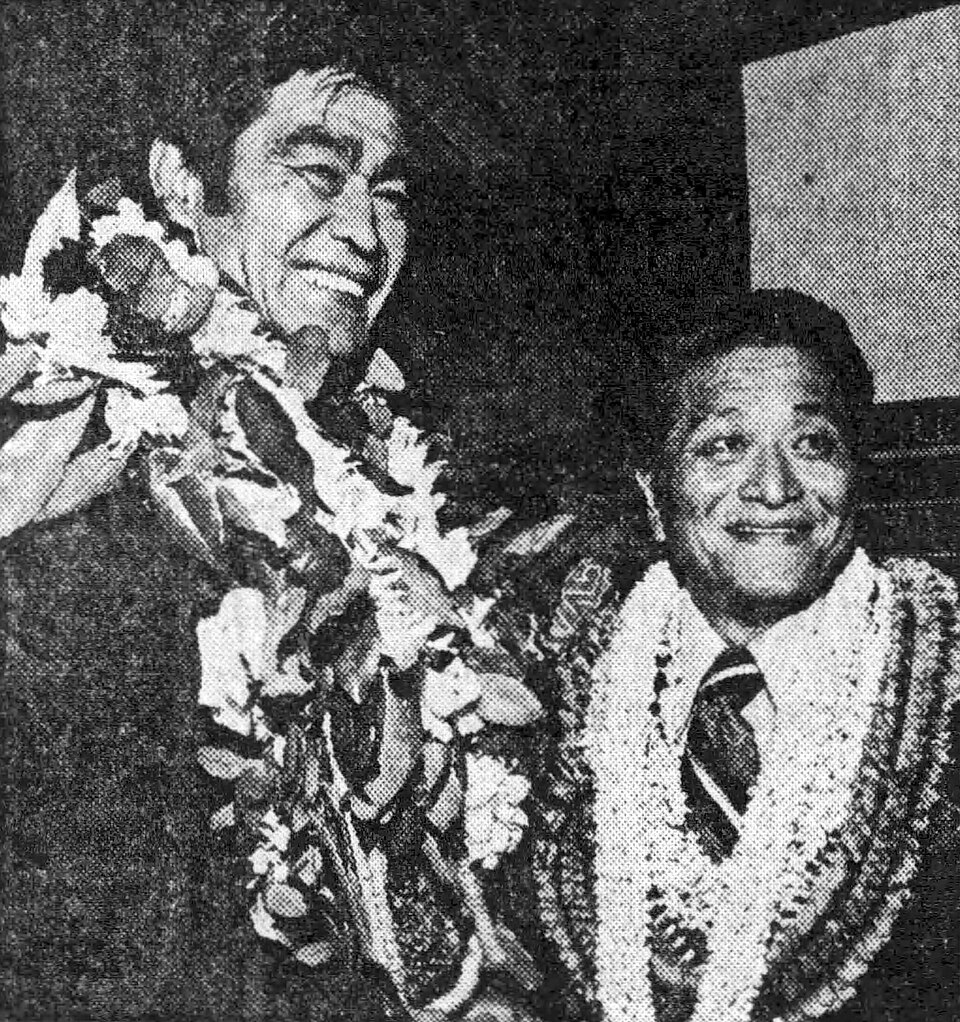
PC: Friends of Ariyoshi/Doi, Public domain, via Wikimedia Commons
During the 7:00 a.m. hour on April 20th, just when the people of the State of Hawaiʻi were getting ready for work, news came down that Hawaiʻiʻs third governor since statehood, George Ariyoshi, passed away at the age of 100.
For the start of a week that was full of other political events in the state, the news of the passing brought a needed pause and reflection on the passing of a political generation that helmed Hawai’i’s emergence from a plantation territory to a modern state.
However, to this blogger, the impact of Ariyoshi’s presence in the Hawaiʻi political realm didnʻt come from his 12-year service as Hawai’i’s governor (which made him the longest serving, something which term limit laws allow governors now to only serve a maximum of 8 years). It was not how he governed (noting his fiscal prudence as policy for the state), nor how he broke barriers for Asian Americans, becoming the first governor of Japanese heritage to serve as a state governor.
It came from a telling of a story, of him giving a speech during the election of 1970, and how, in that moment, that event and in that room, a political figure emerged through a speech that could only be seen as a masterclass in delivery.
In the book “Catch a Wave” by Tom Coffman, he told the story about this speech, given by Ariyoshi, in a chapter entitled “Okage-sama de”, a Japanese phrase that means, in English, “I am what I am because of you.”, Coffman describes this speech, and what it meant to both the person, the people in the room, and what would be the State of Hawaiʻi.
With condolences to his family, we return to a moment that didn’t just introduce George Ariyoshi—it showed, quietly, just how good he already was.
When George Ariyoshi took the podium, he opened by thanking his friends in Japanese: “Okage sama de,” meaning, I am what I am because of you. He also said that this was a new experience for him, that he wanted to speak from the heart, and he instructed the press corps that he would depart from his prepared text. For someone who was portraying himself as a novice at big-time campaigning, Ariyoshi was proceeding masterfully. Following his greeting of “Okake sama de,” Ariyoshi wove his way from the glitter of the moment back to the darkness of the old days.
“Having been born on the corner of Smith and Pauahi streets [a corner in the central city which in 1970 was dominated by tense black faces which spoke of truly intense discrimination], I am literally a product of the slums,” Ariyoshi said, “In reality, I am your product, for itʻs been said that no man lives in a vacuum. And what little measure of success I have attained has been the result of the help and efforts of so many of you.”
Ariyoshiʻs voice broke, and he was silent for several seconds, and then he composed himself and recalled that as a child in grade school he had decided to become a lawyer. He had confided this ambition to his father, who had come from Japan and was a sumo wrestler, and operated a laundry. And his father had told him that to realize this dream of becoming an attorney, “I could have the shirt off his back.”
Ariyoshi settled his eyes on his three children, the grandchildren of the sumo wrestler Ryozo Ariyoshi. The candidate for the second highest office in Hawaii, addressing his children by name, told them they were lucky to live in America, particularly lucky to live in a state “where government places its emphasis on people and human dignity, where your education and your enjoyment of life are given such high priority, where there is equality of opportunity, and where you can dream, and dreams become real if we work for them.”
“But Hawaii was not always like this, for we didnʻt always have equality of opportunities and people were not always advanced in business on the basis on their abilities. Better job opportunities were not always available to all.”
“If any man in Hawaii is to be given credit for this change, it is your present governor,” Ariyoshi said to his children, “our dear friend, John A. Burns.”
The assembled crowd cheered spontaneously, wildly – Ariyoshi had succeeded in spanning the years of affluence, had succeeded in reminding them of the sweet taste of equality following the several decades of second-class citizenship. And in this context, John Burns was not merely a two-term governor but a champion of entire races who had felt the weight of discrimination.
In the psychological flavor of George Ariyoshiʻs appeal, the past, the battles of 1941 and 1954, was anything but a long-ago past. It was real, immediate, only yesterday.
From that night foward, wherever Ariyoshi would go througout the campaign, he would bring to life the past, telling and retelling the story of 1954, of how as a young graduate of law school he had found the path of opportunity closed, and of how John Burns, then a struggling and controversial ex-cop, had told him to get involved in politics and to help build a new order, one in which each man could rise according to his own ability.
Ariyoshi was running as the personification of a dream come true.
~ Catch A Wave Okage-sama de pages 94-95
What made this speech a masterclass wasn’t just the story—it was how Ariyoshi told it. He opened with humility, grounded himself in shared struggle, and then connected that past to a present political promise that the audience could feel was already within reach.
To get an audience to believe what is being said could actually happen—that’s the political sweet spot.
Many aim for it.
Very few reach it.
Ariyoshi did.