
On Wednesday, July 29th, Politics Hawaii, along with other fine publications from throughout the State of Hawaii, convened at the Japanese Cultural Center in Honolulu for the annual Hawaii Chapter of the Society of Professional Journalists Award ceremony.
The ceremony announces the awards for publications, articles, and pieces nominated for the 2025 reporting year. Entries submitted by each of the publications are seen by a team of judges in another state and publication market. For this year, SPJ Hawaii publications and productions were judged by the San Diego and East Tennessee chapters of SPJ.
PC: PHwSF
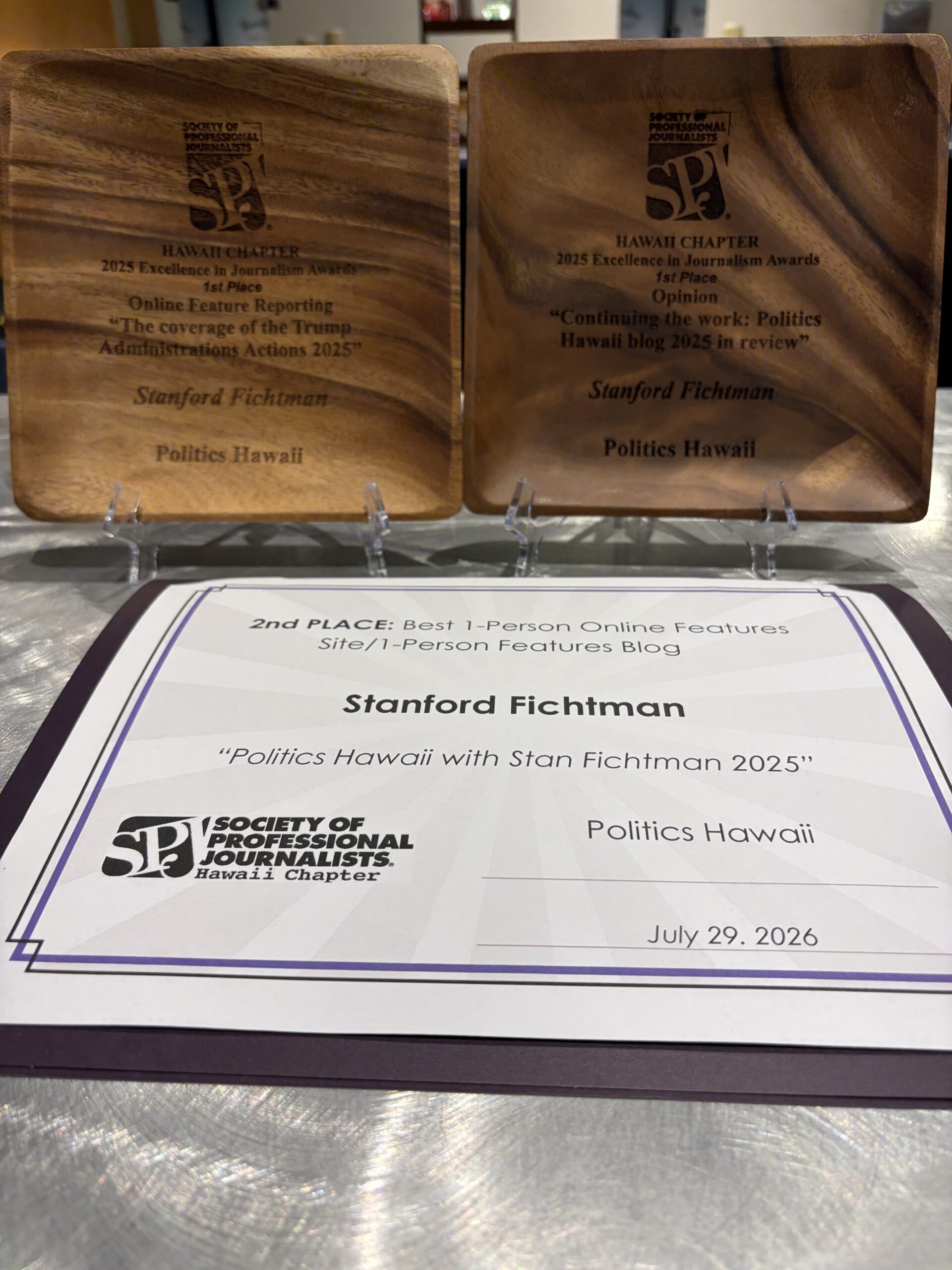
Politics Hawaii was among the publications recognized during the evening, earning three awards: first place in the categories of “Opinion” and “Online Feature Reporting”, and second place in “Best 1-Person Online Features Site/1-Person Features Blog”.
For the last award, in the last two years before this, it won first place in this category. But this year, first place went to Nancy Cook Lauerʻs All Hawaii News. Politics Hawaii is more than happy to tip its hat to Lauer for this achievement, and after the awards were given, kind words were expressed by Lauer for the coverage done by Politics Hawaii.
However, there were many more awards given, and who got them is also part of a larger story of how Hawaiiʻs publication world is evolving.
The first storyline from the event is the emergence of a new publication in Hawaiʻi – Aloha State Daily. They started their work last year, and this is the first year they put work in for awards consideration.
And their final take was pretty impressive. ASD took 17 awards, including Best Overall News Site. They also received awards in headlines, photography, and explanatory journalism.
Not bad for a first-year rookie publication.
For this blogger, it was nice to see a former editorial employee; Pacific Business News was largely absent from the awards last year, but returned in force this year. They earned awards in business reporting, feature writing, explanatory journalism, and long-form reporting. They were a powerhouse in the past when the category of non-daily publications was still active, with their work taking many top honors.

PC: The Molokai Dispatch website
Another breakout publication that did well in this year’s awards was the Molokaʻi Dispatch, and its writer Leo Azambuja. His pieces won first place in categories like community reporting, spot news reporting, and general news/enterprise reporting. The total haul for Molokaʻi Dispatch was 7 individual awards.
Not bad for a publication working in one of the smallest newspaper markets in Hawaiʻi.
One noticeable change from previous years was the smaller showing by Honolulu Civil Beat. In prior years, their haul of awards was impressive, with their table having stacks of first-place awards that looked like a small skyscraper.
This year they took 2, one second place and one third place. And they both were written by a columnist who is featured in the publication from time to time, Eric Stinton.
Beyond who won the awards, what was just as interesting was the type of journalism that was recognized this year. Looking through the winning entries, several themes began to emerge.
Lahaina’s recovery from the 2023 wildfires continued to generate some of the strongest reporting, with stories examining everything from rebuilding efforts and housing to the long-term mental health of survivors.
Government accountability was another recurring theme, with journalists being recognized for reporting on immigration enforcement, police practices, county development decisions, and housing policy.
Healthcare, Native Hawaiian culture, education, and community life also figured prominently among the winners.
Looking at the results as a whole, the awards suggest that Hawaiʻi journalism is less interested in covering politics for politics’ sake than in explaining how decisions made in government, business, and the community affect people’s everyday lives.
That may have been one of the most telling takeaways from the evening.
As a final observation, unlike many award ceremonies, there was little sense of competition once the winners were announced. Reporters from competing news organizations applauded one another, congratulated each other between presentations, and celebrated good journalism regardless of where it appeared.
It was a reminder that while Hawaiʻi’s media outlets compete every day for readers and viewers, the profession itself remains a close-knit community. While journalism as an industry has changed dramatically over the past decade, the spirit of the people practicing it—from established daily newspapers to independent blogs—continues to treat good journalism with mutual respect.