
Election season in Hawaii has arrived, with signs being hung, posted, or otherwise erected for candidates running for office. The fact that this happens every two years is about as newsworthy as telling everyone that the sun comes up every morning in the east.
In other words, not very newsworthy.
However, there are those examples of sign posting that pique the interest of this blogger when out and about. That has to do with the posting of banners for a candidate in an area outside of their district.
Like, really outside.

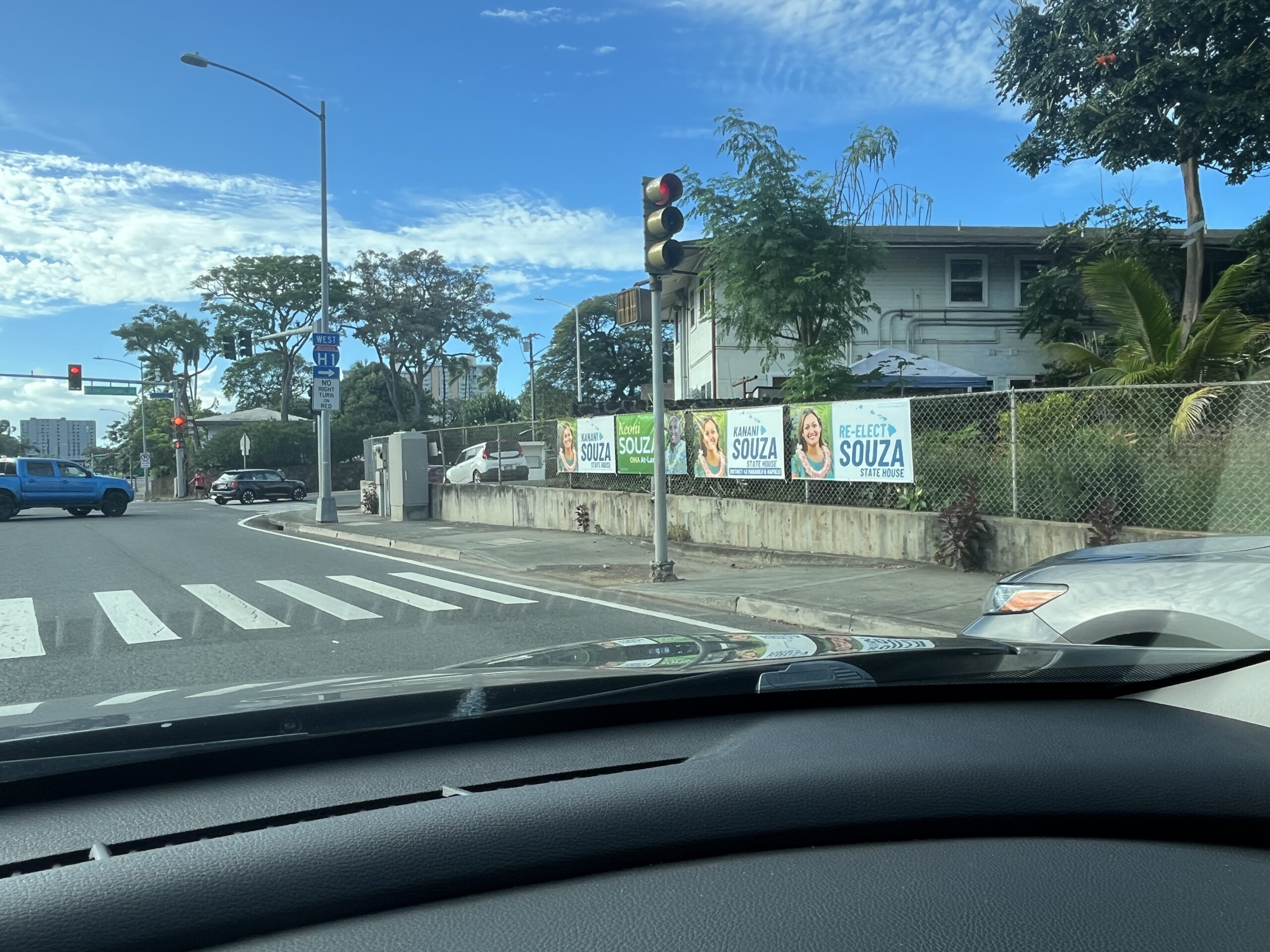
PC: PHwSF – Stan Fichtman
The observation came while waiting for the stoplight to change, at the corner of Vineyard Blvd. and Punchbowl. At that location, there is a wall that faces toward the south, in which drivers see while driving up toward the HI West entry or to the Pali.
The sign posted there is of a candidate that does not live in the area, or a statewide candidate for that matter, but for a House member that lives in Makakilo – approximately 25 miles west of downtown, in the hills above Kapolei. The candidate is Representative Kanani Souza, District 43.
Now, one could be forgiven for being confused: “Why is a candidate running for office in Makakilo posting signs in the heart of Downtown Honolulu?” After all, most candidates who do put up signs have just enough money to cover their district, and really donʻt bleed into other districts to get the word out.
But in this case, there is more to the story.
The first part has to do with a strategic identification that a good amount of the constituency that lives in the district works in town. If one questions that assumption, simply watch one of the local morning shows where they report on traffic, and you will find that there are a lot of people who live in the west, but spend a good amount of time traveling and working in town.
So, in essence, Souza is speaking to the constituency where they are at.
The second part has to do with the nature of the race in that area, and Souzaʻs actions in that representation. As a follower of Hawaii politics may know, Kanani Souza is a Representative who identifies as a Republican, but does not caucus with the party in the House. This is because, soon after she got freshly elected, she limited her interaction with the Republican caucus and has not returned.
Then, she branched out and, along with Democratic Representative Della Au Belatti, drove a campaign to have the Legislature investigate the $35,000 “bribe in a bag” saga that has engulfed at least the Lt. Governor, and is under investigation by the Attorney Generalʻs office.
With that, Souza has drawn a primary challenger. So, as said in Shakespeare’s Henry V (Act 3, Scene 1), “The gameʻs afoot.”
But going back to sign placement, to this blogger, this is the first time they have seen a sign posted for a candidate in a vastly different district than the one they are running in. In campaigns past, candidates may post signs in the neighboring districts, just to capture the “on the district border” folks whose address is right against another district.
So, with the example that Souza is providing in this race, is the traditional definition of where a candidate’s sign is placed about to be redefined? If more campaigns start to follow the example, that would be a good sign that the definition has changed.
However, the more pointed question is whether “district presence”, especially here on Oahu, is changing, with campaigns realizing that if voters don’t spend their day in their district, should campaigns?